






How to Select Single Jersey for Laminated Autumn/Winter Sportswear
I. For Laminated Single Jersey, Look First at Crosswise Elasticity and Recovery
Sportswear often requires raising the arms, bending, and stretching, and the crosswise elasticity of knitted single jersey affects the movement performance of the laminated fabric. However, greater elasticity is not always better.
If the outer woven fabric is basically non-elastic while the inner single jersey has a large crosswise elongation, the difference in stretch between the two layers after lamination may increase the risk of wrinkling and dimensional change. For stretch sportswear fabrics, single jersey should be selected to match the actual elongation and recovery performance of the outer layer.
When selecting fabric, in addition to measuring crosswise elongation, the recovery after stretching should also be observed. It is not enough to see only whether the fabric can be stretched; it is also necessary to see whether residual deformation is likely to remain after relaxation.China Shenghong Laminated Single Jersey Factory

II. Why Check the Thermal Shrinkage of Single Jersey When Wrinkling Occurs After Lamination?
After hot-press lamination, knitted single jersey may undergo dimensional change due to heat. If there is a large difference in thermal shrinkage between the single jersey and the outer fabric, the surface may become uneven, wavy edges may appear, or localized wrinkling may occur after lamination.China Shenghong Knitted Single Jersey Manufacturer
Therefore, when using polyester single jersey, it is not enough to compare only gram weight and hand feel; its heat setting and thermal shrinkage should also be understood. For sports jackets with high requirements for flatness, it is recommended to conduct comparative heat treatment before confirming the fabric and observe dimensional changes.
In particular, it should be noted that single jersey may perform differently under different temperatures and heating times, and the effect after lamination cannot be judged solely by dimensional stability at room temperature.
III. What Effects Does Surface Fuzzing of Single Jersey Have After Lamination?
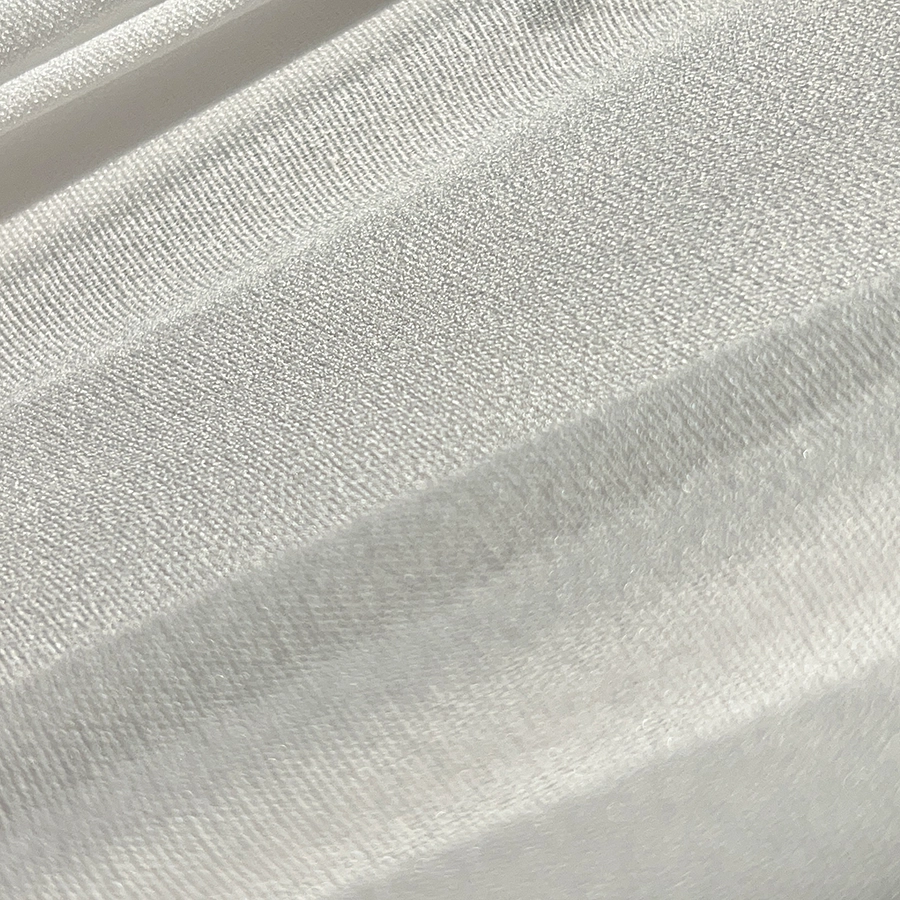
The surface condition of knitted single jersey also deserves attention. If there is obvious fuzz, snagging, or uneven structure on the fabric surface, it may affect the inner appearance and touch after lamination; if the fabric is used for sportswear subject to frequent friction, fuzzing and pilling performance should also be considered according to product requirements.
When selecting samples, check whether the fabric surface is uniform, and confirm whether the pilling, abrasion resistance, and other indicators of the selected fabric meet the garment requirements. For close-to-body styles, the inner touch should also be judged based on the actual state after lamination, rather than only feeling the un-laminated single jersey.
IV. Choose the Right Single Jersey to Make Sportswear Lamination More Suitable
For knitted single jersey used in laminated autumn/winter sportswear, there is no need to pursue high gram weight or high elasticity blindly; the key is to meet the actual requirements of the finished garment. Lightweight sportswear should avoid becoming too heavy after lamination, while stretch sportswear should avoid the inner layer restricting wearing movement.
For sportswear styles under long-term development, choosing suitable knitted single jersey not only affects the fabric performance after lamination, but also helps maintain the flatness and elastic stability of the finished garment.